

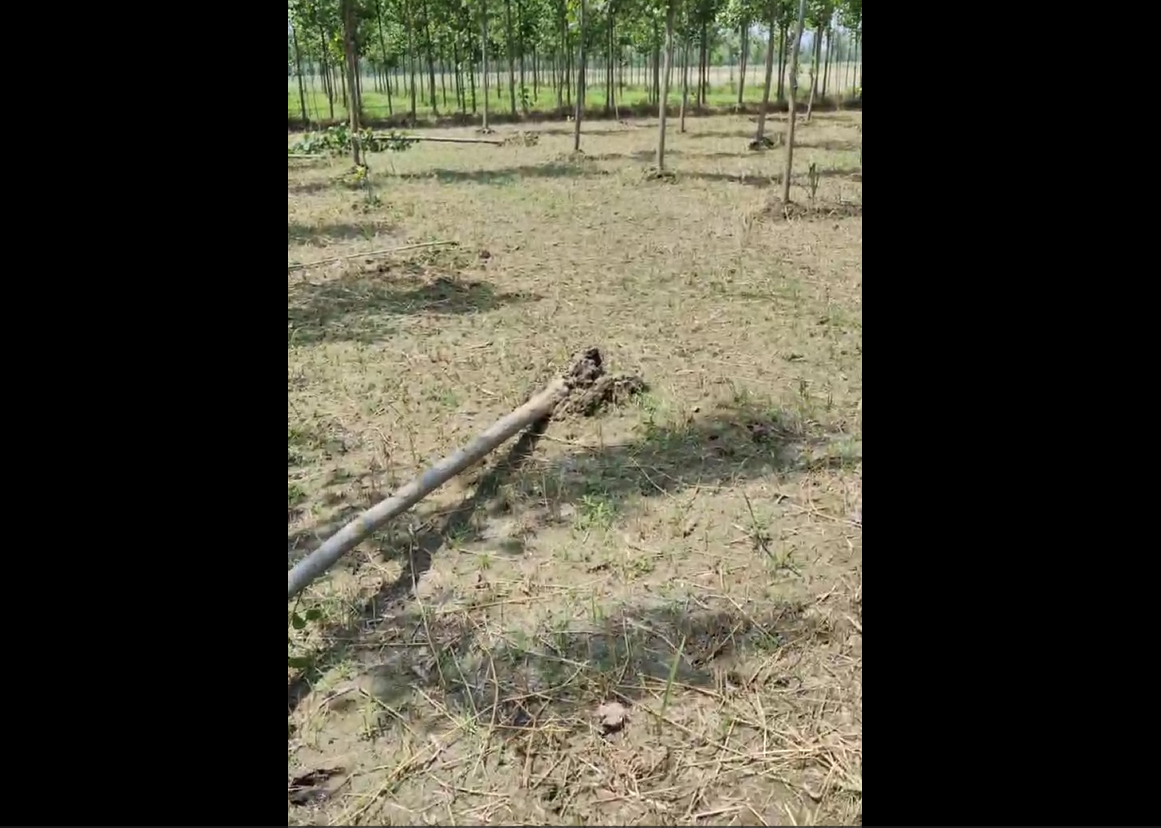
Many farmers growing Poplar tree face a common problem during monsoon season — young trees bending, leaning, or completely uprooting after heavy rain and wind.
If your one-year-old poplar trees are repeatedly falling after rain, the issue is usually not just wind. In most cases, weak root anchoring and poor root development are the main reasons.
Why Do Poplar Trees Fall After Rain?
Young poplar trees commonly fall due to the following reasons:
- Roots did not grow deep enough
- Soil becomes too soft or waterlogged
- Trees grew rapidly in height but root anchoring remained weak
- Cutting plantation depth was too shallow
- Excess nitrogen fertilizer caused tall, thin growth
When fast top growth combines with soft wet soil and strong winds, uprooting becomes much more likely.
How to Prevent Poplar Trees from Falling ->
1. Strengthen the Soil Basin Around the Tree
Press and compact soil firmly around each tree after rain.
You can create a broad shallow basin around the tree to:
- improve stability
- encourage side root development
- strengthen soil support
Avoid creating steep volcano-style mounds touching the trunk.
2. Use Bamboo Support
Provide bamboo or wooden support for 2–3 months if trees are leaning badly.
Continuous movement in wind can:
- break newly forming roots
- weaken anchoring
- delay recovery
A triangular support system usually works best.
3. Improve Drainage
Root rot risk increases when water remains stagnant in the field.
To reduce damage:
- create drainage channels
- remove standing water quickly
- maintain proper soil aeration
4. Apply Root Growth Promoters
The following treatments can help improve root development:
- Humic Acid
- Seaweed Extract
- Low-dose phosphorus fertilizer
- Mycorrhiza
- PSB biofertilizer
These encourage feeder root growth and better root branching.
5. Reduce Nitrogen Temporarily
If excessive urea or nitrogen fertilizer is being used, reduce it for some time.
Too much nitrogen often causes:
- rapid height growth
- weak stem structure
- lower wind resistance
Balanced nutrition is more important than fast growth.
6. Perform Light Deep Hoeing
Light hoeing slightly away from the trunk helps:
- loosen compact soil
- improve oxygen movement
- encourage deeper root spread
This helps roots grow downward instead of remaining shallow.
Most Effective Recovery Combination
If trees are already leaning heavily, this combination is often highly effective:
- Re-straighten the tree
- Press soil firmly around roots
- Add 2 bamboo supports
- Apply humic acid
Significant improvement can often be seen within 2–3 months.
Important Warning About Volcano Mulching
Building tall soil cones directly touching the trunk is usually not recommended for Poplar tree because it may increase:
- stem rot
- fungal infection
- shallow surface rooting
Instead:
- create a wide shallow basin
- keep the stem collar exposed
- maintain proper drainage
Conculsion
With proper management, young Poplar tree can recover and develop stronger root systems capable of resisting future wind and rain damage.
Early intervention is critical. Proper soil support, drainage management, balanced fertilization, and temporary support systems can greatly improve tree stability and long-term timber quality.
If you are facing similar problems in your plantation, TreeKisan can help analyze field conditions based on plantation photos and root-zone images.
For more information visit -> download Treekisan app


Rohit Kansay

An engineer with a strong interest in agroforestry and farm economics, he shares practical, data-driven insights on poplar and eucalyptus farming, timber pricing in India, and wood market trends, drawing from industry observations and field-level experience.
Leave a Reply